Save this comprehensive AI business guide to your device and access it anytime, even offline.
Instant download • No additional sign-up required • 100% Free
About the Author
Indea "Indygo" Leary
Founder, 1NDYGO AI SOLUTIONS
Indea Leary is an innovative entrepreneur and AI business strategist who founded 1NDYGO AI SOLUTIONS to bridge
the gap between artificial intelligence potential and practical business implementation. With a passion for
demystifying AI technologies and making them accessible to businesses of all sizes, Indea specialises in
translating complex AI concepts into actionable business strategies that deliver measurable ROI.
As the founder of 1NDYGO AI SOLUTIONS, Indea brings a fresh perspective to AI business integration, focusing
on practical frameworks and proven methodologies that help organisations navigate the trillion-dollar AI
opportunity. Her approach combines strategic business acumen with deep understanding of AI technologies to
create customised solutions that drive real business results.
Through 1NDYGO AI SOLUTIONS, Indea is committed to empowering business leaders with the knowledge, tools, and
confidence needed to successfully implement AI solutions that transform operations, enhance customer
experiences, and create sustainable competitive advantages.
Table of Contents
Separating AI Myths from Reality in Business
Understanding AI's True Business Value
Industry-Specific AI Applications
Building Your AI-Ready Business Foundation
The 90-Day AI Implementation Framework
Measuring AI ROI and Success Metrics
AI Solutions for Small to Medium Businesses
Chapter 1: Separating AI Myths from Reality in Business
In today's rapidly evolving business landscape, artificial intelligence represents both unprecedented
opportunity and widespread misunderstanding. As AI technologies continue to reshape industries and transform
operations, business leaders face a critical challenge: separating fact from fiction in a field saturated with
myths, misconceptions, and media hype.
This comprehensive guide addresses the most persistent AI myths that influence business decision-making in 2025.
Each myth presented here has been carefully selected based on its prevalence in executive discussions, its
potential impact on strategic planning, and the real-world consequences of believing these misconceptions.
At 1NDYGO AI SOLUTIONS PTY LTD, we encounter these myths daily in our work with organisations across diverse
industries. Our mission is to provide clarity, evidence-based insights, and practical guidance that empowers
business leaders to make informed decisions about AI implementation and strategy.
1
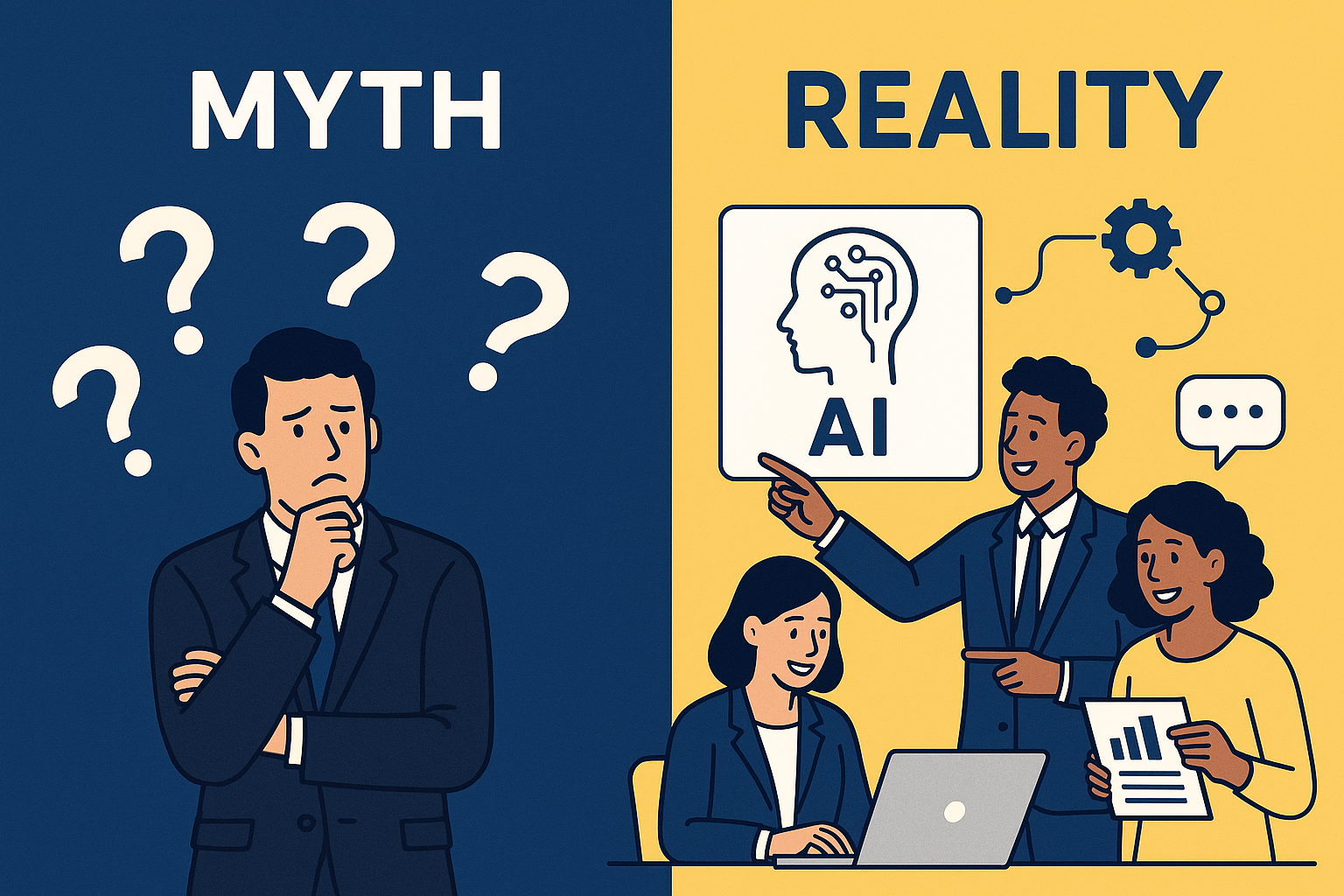
AI Will Replace All Human Jobs
❌ The Myth
AI will lead to mass unemployment as machines become capable of performing all human tasks, making workers
obsolete across all industries and skill levels.
✅ The Reality
AI augments human capabilities rather than replacing them entirely. While some roles transform, new job
categories emerge. Success comes from human-AI collaboration, not replacement.
Business Impact:
Focus on reskilling initiatives and identifying where AI can enhance employee productivity rather than
planning wholesale workforce reductions.
2
AI Is Too Expensive for Small Businesses
❌ The Myth
AI implementation requires massive budgets, specialised infrastructure, and teams of data scientists that
only large corporations can afford.
✅ The Reality
Cloud-based AI services, subscription models, and no-code platforms make powerful AI tools accessible to
businesses of all sizes, often starting under $100/month.
Business Impact:
Start with low-cost AI tools for specific pain points. Scale gradually based on ROI and business growth
rather than waiting for large budget allocations.
3
AI Requires Extensive Technical Expertise
❌ The Myth
Implementing AI requires teams of machine learning engineers, data scientists, and technical specialists
that most businesses cannot afford or find.
✅ The Reality
Modern AI platforms offer intuitive interfaces, drag-and-drop functionality, and pre-built solutions that
business users can implement without coding knowledge.
Business Impact:
Empower existing staff with user-friendly AI tools. Invest in training rather than hiring expensive
specialists for basic AI implementations.
4
AI Makes Perfect, Unbiased Decisions
❌ The Myth
AI algorithms always produce superior, objective decision-making compared to human judgement, free from
bias and error.
✅ The Reality
AI systems can perpetuate and amplify existing biases in training data. They lack human intuition, ethical
reasoning, and contextual understanding crucial for complex decisions.
Business Impact:
Maintain human oversight for all AI decisions. Implement bias testing and ensure diverse perspectives in AI
system design and monitoring.
5
AI Implementation Delivers Instant Results
❌ The Myth
AI can be deployed quickly with immediate, transformative results across all business operations within
weeks of implementation.
✅ The Reality
Successful AI implementation requires strategic planning, data preparation, staff training, testing
phases, and continuous optimisation over months or years.
Business Impact:
Set realistic timelines and expectations. Plan for gradual rollouts with measurable milestones rather than
expecting immediate transformation.
🎯 Strategic Business Takeaways
Start with specific business problems rather than technology-first approaches
Invest in data quality and organisation before AI implementation
Focus on augmenting human capabilities rather than replacing them
Choose industry-specific AI solutions for maximum effectiveness
Plan for gradual implementation with proper training and support
Maintain human oversight and ethical guidelines for all AI decisions
Measure ROI through clear metrics aligned with business objectives
Build AI literacy across your organisation, not just in IT
Prioritise security and compliance from day one
Stay informed about AI developments relevant to your industry
Chapter 2: Understanding AI's True Business Value
Understanding the true business value of artificial intelligence requires moving beyond the hype and examining
concrete, measurable benefits that AI can deliver to organisations. This chapter explores the fundamental ways
AI creates value, provides frameworks for evaluating AI opportunities, and offers practical guidance for
maximising return on investment.
The Four Pillars of AI Business Value
1. Operational Efficiency
AI excels at automating repetitive tasks, optimising processes, and reducing human error. By taking over routine
operations, AI frees human workers to focus on higher-value activities that require creativity, emotional
intelligence, and strategic thinking.
Practical Applications:
Automated data entry and processing, reducing manual errors by up to 95%
Intelligent scheduling and resource allocation that optimises utilisation
Predictive maintenance that prevents costly equipment failures
Automated quality control that maintains consistent standards
Smart inventory management that reduces waste and stockouts
2. Enhanced Decision Making
AI's ability to process vast amounts of data and identify patterns invisible to human analysis provides
organisations with unprecedented insights for strategic decision-making. This data-driven approach reduces
guesswork and improves outcomes across all business functions.
Key Benefits:
Real-time market analysis that identifies trends and opportunities
Customer behaviour prediction that informs product development
Risk assessment that protects against potential threats
Performance analytics that optimise marketing campaigns
Financial forecasting that improves budget planning and resource allocation
3. Customer Experience Transformation
AI enables personalised, responsive customer experiences that were previously impossible at scale. By
understanding individual customer preferences and behaviours, businesses can deliver targeted solutions that
increase satisfaction and loyalty.
Customer Experience Enhancements:
24/7 intelligent customer support through chatbots and virtual assistants
Personalised product recommendations that increase sales conversion
Dynamic pricing that optimises revenue whilst maintaining customer satisfaction
Predictive customer service that addresses issues before they escalate
Customised content delivery that engages users more effectively
4. Innovation and New Revenue Streams
AI doesn't just improve existing processes; it enables entirely new business models and revenue opportunities.
By leveraging AI capabilities, organisations can create innovative products and services that differentiate them
in the marketplace.
Innovation Opportunities:
AI-powered products that provide new value propositions
Data monetisation through insights and analytics services
Platform business models that connect multiple stakeholders
Subscription services based on AI-driven personalisation
Marketplace opportunities that leverage AI matching algorithms
Measuring AI Business Value
To realise AI's potential, organisations must establish clear metrics and measurement frameworks. Value
measurement should encompass both quantitative and qualitative benefits, with regular assessment to ensure
initiatives remain aligned with business objectives.
Quantitative Metrics
Cost Reduction: Measure savings from automation, efficiency improvements, and error reduction
Revenue Growth: Track increases from new capabilities, better customer targeting, and
improved products
Productivity Gains: Quantify improvements in output per employee and process cycle times
Quality Improvements: Measure reductions in defects, errors, and customer complaints
Time Savings: Calculate hours saved through automation and optimisation
Qualitative Benefits
Employee Satisfaction: Assess improvements in job satisfaction and engagement
Customer Satisfaction: Monitor customer feedback and loyalty metrics
Strategic Agility: Evaluate ability to respond quickly to market changes
Competitive Advantage: Assess positioning relative to competitors
Brand Reputation: Monitor perception improvements and market positioning
Common Value Creation Mistakes
Many organisations fail to realise AI's full potential due to common implementation mistakes. Understanding
these pitfalls helps ensure successful value creation:
Technology-First Approach: Focusing on AI capabilities rather than business problems leads to
solutions in search of problems.
Unrealistic Expectations: Expecting immediate, transformative results without proper planning
and implementation.
Insufficient Data Preparation: Underestimating the importance of clean, organised data for AI
success.
Lack of Change Management: Failing to prepare employees and processes for AI integration.
Inadequate Success Metrics: Not establishing clear, measurable criteria for AI success.
Building a Value-Driven AI Strategy
Creating a successful AI strategy requires aligning technology capabilities with business objectives. This
process involves systematic evaluation of opportunities, prioritisation based on value potential, and
implementation with clear success criteria.
Step 1: Business Problem Identification
Conduct thorough analysis of current business challenges and inefficiencies
Prioritise problems based on impact, cost, and feasibility of AI solutions
Engage stakeholders to understand pain points and desired outcomes
Map problems to potential AI solution categories
Step 2: Opportunity Assessment
Evaluate technical feasibility of AI solutions for identified problems
Assess data availability and quality requirements
Estimate implementation costs and resource requirements
Calculate potential return on investment for each opportunity
Step 3: Strategic Prioritisation
Rank opportunities based on value potential and implementation complexity
Consider strategic alignment with long-term business objectives
Assess organisational readiness and change management requirements
Select initial pilot projects with high success probability
Step 4: Implementation Planning
Develop detailed project plans with clear milestones and success criteria
Allocate necessary resources and expertise
Establish governance structures and decision-making processes
Plan for change management and stakeholder communication
🎯 Chapter 2 Key Takeaways
AI creates value through operational efficiency, enhanced decision-making, customer experience
transformation, and innovation
Successful AI implementation requires both quantitative and qualitative measurement frameworks
Focus on business problems first, then identify appropriate AI solutions
Avoid common mistakes by setting realistic expectations and preparing adequately
Build value-driven AI strategies through systematic problem identification and opportunity assessment
Prioritise initiatives based on value potential, feasibility, and strategic alignment
Establish clear governance and success criteria for all AI initiatives
Chapter 3: Industry-Specific AI Applications
While AI principles remain consistent across industries, successful implementation requires understanding
sector-specific challenges, regulations, and opportunities. This chapter explores how different industries
leverage AI to solve unique problems and create competitive advantages.
Healthcare: Transforming Patient Care and Operations
Healthcare organisations face unique challenges including regulatory compliance, patient safety requirements,
and complex data privacy laws. AI applications in healthcare focus on improving patient outcomes, reducing
costs, and enhancing operational efficiency whilst maintaining strict quality and safety standards.
Key Healthcare AI Applications
Diagnostic Assistance: AI-powered imaging analysis helps radiologists detect diseases earlier
and more accurately. Machine learning algorithms can identify patterns in X-rays, MRIs, and CT scans that might
be missed by human analysis.
Predictive Analytics: Healthcare providers use AI to predict patient deterioration, readmission
risks, and disease progression. This enables proactive interventions that improve outcomes and reduce costs.
Drug Discovery: Pharmaceutical companies leverage AI to accelerate drug development by
identifying promising compounds, predicting drug interactions, and optimising clinical trial design.
Personalised Treatment: AI analyses patient data, genetics, and treatment history to recommend
personalised treatment plans that maximise effectiveness whilst minimising side effects.
Healthcare Implementation Considerations
HIPAA compliance and patient data privacy requirements
FDA approval processes for AI-powered medical devices
Integration with existing electronic health record systems
Staff training and workflow adaptation
Patient acceptance and trust in AI-assisted care
Financial Services: Risk Management and Customer Experience
Financial institutions operate in highly regulated environments with stringent compliance requirements. AI
applications focus on fraud detection, risk assessment, customer service, and regulatory compliance whilst
maintaining transparency and explainability.
Key Financial Services AI Applications
Fraud Detection: Real-time transaction monitoring uses AI to identify suspicious patterns and
prevent fraudulent activities. Machine learning models continuously adapt to new fraud techniques.
Credit Scoring: AI-enhanced credit assessment considers alternative data sources and complex
patterns to make more accurate lending decisions, particularly for underserved populations.
Algorithmic Trading: Investment firms use AI to analyse market data, identify trends, and
execute trades at optimal times to maximise returns and minimise risks.
Customer Service: Intelligent chatbots and virtual assistants handle routine customer
inquiries, providing 24/7 support whilst freeing human agents for complex issues.
Financial Services Implementation Considerations
Regulatory compliance with financial industry standards
Model explainability and transparency requirements
Data security and customer privacy protection
Integration with legacy banking systems
Risk management and model validation processes
Retail and E-commerce: Personalisation and Supply Chain Optimisation
Retail businesses use AI to understand customer behaviour, optimise inventory, personalise experiences, and
streamline operations. The focus is on increasing sales, improving customer satisfaction, and reducing
operational costs.
Key Retail AI Applications
Recommendation Engines: Personalised product recommendations increase sales by suggesting items
based on customer history, preferences, and behaviour patterns.
Inventory Optimisation: AI predicts demand patterns, optimises stock levels, and reduces waste
whilst ensuring product availability.
Dynamic Pricing: Real-time price optimisation considers demand, competition, inventory levels,
and customer segments to maximise revenue.
Customer Analytics: AI analyses customer journey data to identify pain points, optimise
marketing campaigns, and improve conversion rates.
Retail Implementation Considerations
Integration with e-commerce platforms and point-of-sale systems
Real-time data processing for dynamic pricing and recommendations
Customer privacy and data protection compliance
Seasonal demand variations and trend prediction
Multichannel experience consistency
Manufacturing: Predictive Maintenance and Quality Control
Manufacturing industries leverage AI to optimise production processes, predict equipment failures, ensure
quality control, and improve safety. The focus is on reducing downtime, minimising defects, and maximising
operational efficiency.
Key Manufacturing AI Applications
Predictive Maintenance: AI monitors equipment sensors to predict failures before they occur,
reducing unplanned downtime and maintenance costs.
Quality Control: Computer vision systems inspect products for defects with greater accuracy and
consistency than human inspectors.
Supply Chain Optimisation: AI optimises production schedules, supplier selection, and logistics
to reduce costs and improve delivery times.
Energy Management: Smart systems optimise energy consumption by predicting demand patterns and
adjusting operations accordingly.
Manufacturing Implementation Considerations
Integration with industrial IoT sensors and control systems
Real-time processing requirements for production lines
Safety and reliability standards for industrial environments
Worker training and acceptance of AI-powered systems
Scalability across multiple production facilities
Transportation and Logistics: Route Optimisation and Autonomous Systems
Transportation companies use AI to optimise routes, predict maintenance needs, improve safety, and enhance
customer experience. The industry is moving towards autonomous systems and intelligent logistics management.
Key Transportation AI Applications
Route Optimisation: AI analyses traffic patterns, weather conditions, and delivery constraints
to find optimal routes that minimise time and fuel consumption.
Fleet Management: Predictive analytics optimise vehicle utilisation, maintenance scheduling,
and driver assignments to reduce costs and improve service quality.
Autonomous Vehicles: Self-driving technology uses AI to navigate safely, make real-time
decisions, and communicate with other vehicles and infrastructure.
Demand Forecasting: AI predicts transportation demand patterns to optimise capacity planning
and resource allocation.
Transportation Implementation Considerations
Safety regulations and certification requirements
Real-time data processing for navigation and decision-making
Integration with traffic management systems
Driver training and adaptation to AI-assisted systems
Infrastructure requirements for autonomous operations
Education: Personalised Learning and Administrative Efficiency
Educational institutions use AI to personalise learning experiences, improve student outcomes, streamline
administrative processes, and enhance educational accessibility.
Key Education AI Applications
Adaptive Learning: AI-powered platforms adjust content difficulty and teaching methods based on
individual student progress and learning styles.
Automated Grading: AI systems grade assignments and provide feedback, freeing educators to
focus on instruction and student interaction.
Student Analytics: Predictive models identify students at risk of dropping out or failing,
enabling early intervention and support.
Content Creation: AI assists in creating educational materials, quizzes, and curricula tailored
to specific learning objectives.
Education Implementation Considerations
Student privacy and data protection requirements
Integration with existing learning management systems
Teacher training and acceptance of AI-powered tools
Accessibility and equity considerations
Curriculum alignment and educational effectiveness measurement
Cross-Industry Implementation Strategies
While each industry has unique requirements, successful AI implementation follows common principles that can be
adapted across sectors:
1. Regulatory Compliance First
Understand and plan for industry-specific regulations from the beginning. Engage legal and compliance teams
early in the planning process to ensure all AI implementations meet required standards.
2. Data Quality and Integration
Invest in data infrastructure and quality improvement before implementing AI solutions. Poor data quality will
limit AI effectiveness regardless of industry or application.
3. Stakeholder Engagement
Involve all stakeholders, including employees, customers, and partners, in AI planning and implementation.
Address concerns proactively and communicate benefits clearly.
4. Pilot Projects and Scaling
Start with focused pilot projects that demonstrate value and build confidence. Use successful pilots as
foundations for broader AI adoption across the organisation.
5. Continuous Learning and Adaptation
AI implementation is an ongoing process that requires continuous monitoring, learning, and adaptation. Establish
feedback loops and improvement processes from the beginning.
🎯 Chapter 3 Key Takeaways
Each industry has unique AI applications based on specific challenges and opportunities
Regulatory compliance and industry standards must be considered from the beginning
Data quality and integration requirements vary by industry but remain critical for success
Stakeholder engagement and change management are essential across all sectors
Start with pilot projects that demonstrate clear value and business impact
Learn from industry leaders and adapt best practices to your specific context
Focus on solving real business problems rather than implementing technology for its own sake
Chapter 4: Building Your AI-Ready Business Foundation
Before implementing any AI solution, organisations must establish a solid foundation that supports successful AI
adoption. This chapter outlines the essential elements needed to prepare your business for AI transformation,
from data infrastructure to organisational culture.
The Five Pillars of AI Readiness
1. Data Infrastructure and Quality
Data is the fuel that powers AI systems. Without high-quality, accessible data, even the most sophisticated AI
algorithms will fail to deliver meaningful results. Building a robust data infrastructure is the first and most
critical step in AI preparation.
Data Assessment Framework:
Data Inventory: Catalogue all data sources within your organisation, including databases,
files, external sources, and real-time streams
Quality Evaluation: Assess data completeness, accuracy, consistency, and timeliness using
standardised quality metrics
Accessibility Analysis: Determine how easily data can be accessed, integrated, and processed
for AI applications
Governance Review: Evaluate existing data governance policies, privacy controls, and
compliance frameworks
Data Infrastructure Requirements:
Storage Solutions: Implement scalable data storage that can handle growing volumes and varied
data types
Integration Platforms: Deploy tools that can connect disparate data sources and ensure
consistent formatting
Processing Capabilities: Establish systems for cleaning, transforming, and preparing data for
AI consumption
Security Frameworks: Implement robust security measures to protect sensitive data throughout
the AI pipeline
2. Technology Infrastructure
AI applications require specific technology capabilities that may differ from traditional business systems.
Organisations must assess their current technology stack and plan necessary upgrades or additions.
Infrastructure Assessment Areas:
Computing Resources: AI processing, particularly machine learning training, requires
significant computational power. Consider cloud-based solutions for scalability and cost-effectiveness.
Network Capacity: AI applications often require real-time data processing and may generate
substantial network traffic. Ensure adequate bandwidth and low latency connectivity.
Integration Capabilities: AI systems must integrate seamlessly with existing business
applications. Evaluate API capabilities and middleware requirements.
Security Infrastructure: AI systems create new security considerations including model
protection, data privacy, and adversarial attack prevention.
3. Organisational Culture and Change Management
Successful AI adoption requires cultural transformation that embraces data-driven decision-making, continuous
learning, and collaboration between humans and machines.
Cultural Transformation Elements:
Leadership Commitment: Senior leadership must champion AI initiatives, allocate necessary
resources, and model data-driven behaviours throughout the organisation.
Change Management Strategy: Develop comprehensive change management plans that address employee
concerns, communicate benefits, and provide support throughout the transition.
Data-Driven Mindset: Foster a culture that values data insights, empirical evidence, and
measurable outcomes over intuition and tradition.
Collaboration Framework: Create structures that promote collaboration between technical teams,
business users, and external partners.
4. Skills and Capabilities
AI implementation requires new skills and capabilities across the organisation. Rather than hiring extensive AI
expertise, focus on building internal capabilities and strategic partnerships.
Capability Development Strategy:
AI Literacy: Provide basic AI education for all employees to build understanding and reduce
resistance to AI-powered changes.
Technical Skills: Develop or acquire specific technical skills needed for AI implementation,
including data analysis, model development, and system integration.
Business Analysis: Strengthen capabilities in problem identification, requirements gathering,
and solution design for AI applications.
Project Management: Build expertise in managing AI projects, which often involve iterative
development, experimentation, and uncertainty.
5. Governance and Risk Management
AI systems introduce new risks and governance challenges that require proactive management and oversight.
Governance Framework Components:
AI Ethics Policy: Establish clear guidelines for ethical AI use, including fairness,
transparency, and accountability principles.
Risk Assessment: Identify and evaluate AI-related risks including bias, privacy breaches, and
operational failures.
Compliance Management: Ensure AI implementations comply with relevant regulations and industry
standards.
Performance Monitoring: Implement systems to monitor AI performance, detect issues, and ensure
continued effectiveness.
AI Readiness Assessment Tool
Use this comprehensive assessment to evaluate your organisation's readiness for AI implementation:
Data Readiness (25 points)
Data quality and completeness (5 points)
Data accessibility and integration (5 points)
Data governance and security (5 points)
Data volume and variety (5 points)
Real-time data capabilities (5 points)
Technology Readiness (20 points)
Computing infrastructure scalability (5 points)
Integration capabilities (5 points)
Security infrastructure adequacy (5 points)
Cloud readiness (5 points)
Organisational Readiness (25 points)
Leadership support and commitment (5 points)
Change management capabilities (5 points)
Data-driven culture maturity (5 points)
Collaboration and communication (5 points)
Employee readiness and acceptance (5 points)
Skills and Capabilities (20 points)
AI literacy across organisation (5 points)
Technical expertise availability (5 points)
Business analysis capabilities (5 points)
Project management skills (5 points)
Governance and Risk Management (10 points)
Risk management framework (3 points)
Compliance and regulatory readiness (3 points)
Ethical AI guidelines (2 points)
Performance monitoring capabilities (2 points)
Scoring Guide:
80-100 points: AI-ready, proceed with implementation planning
60-79 points: Good foundation, address identified gaps
Below 40 points: Foundation building required before AI implementation
Foundation Building Roadmap
Based on your readiness assessment, follow this structured approach to build your AI foundation:
Phase 1: Assessment and Planning (Weeks 1-4)
Complete comprehensive readiness assessment
Identify priority gaps and improvement opportunities
Develop foundation building project plan
Secure leadership commitment and resource allocation
Establish project governance and communication plans
Phase 2: Quick Wins and Immediate Improvements (Weeks 5-12)
Implement data quality improvements for critical datasets
Begin AI literacy training for key stakeholders
Establish basic governance policies and procedures
Identify and engage potential AI technology partners
Start pilot project planning for low-risk AI applications
Phase 3: Infrastructure and Capability Building (Weeks 13-26)
Implement comprehensive data management platform
Upgrade technology infrastructure as needed
Develop internal AI capabilities through training and hiring
Establish partnerships with AI vendors and consultants
Create detailed AI implementation roadmap
Phase 4: Validation and Optimisation (Weeks 27-39)
Conduct pilot AI projects to test foundation
Refine processes and capabilities based on pilot learnings
Expand AI literacy and capability development
Finalise governance frameworks and risk management
Prepare for full-scale AI implementation
Common Foundation Building Mistakes
Avoid these common pitfalls when building your AI foundation:
Underestimating Data Requirements: Poor data quality and accessibility will undermine any AI
initiative. Invest adequately in data infrastructure.
Neglecting Change Management: Technical implementation without cultural preparation leads to
resistance and failure.
Over-Engineering Solutions: Start with simple, proven technologies before moving to complex
AI platforms.
Ignoring Governance: Establish ethical guidelines and risk management from the beginning, not
as an afterthought.
Rushing Implementation: Take time to build proper foundations rather than rushing to deploy
AI solutions.
🎯 Chapter 4 Key Takeaways
AI success requires strong foundations in data, technology, culture, skills, and governance
Assess your organisation's readiness before beginning AI implementation
Invest in data quality and infrastructure as the first priority
Build AI literacy and capabilities across the organisation, not just in IT
Establish governance and risk management frameworks early
Use a phased approach to foundation building with clear milestones
Learn from pilot projects and adjust your approach based on results
Chapter 5: The 90-Day AI Implementation Framework
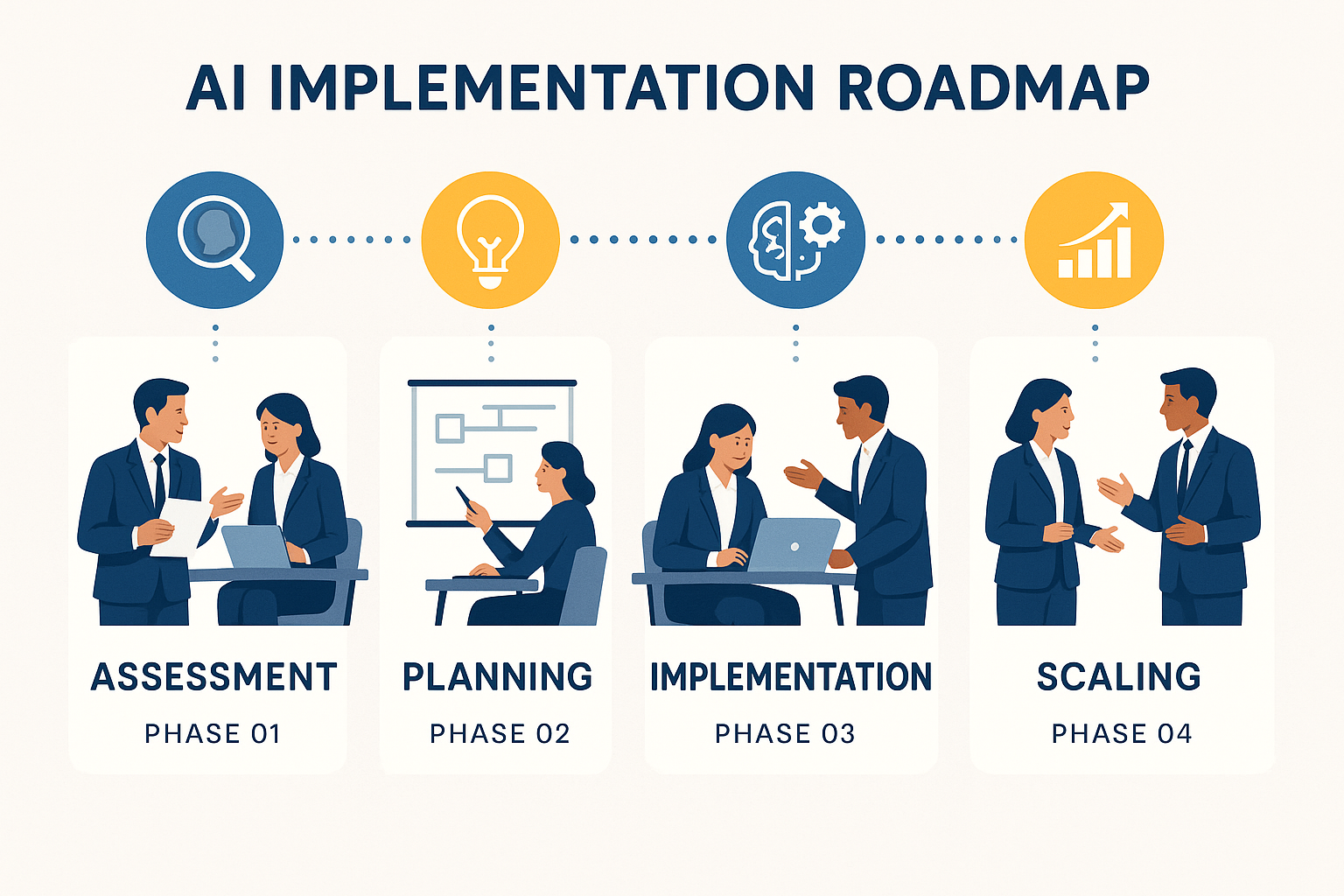
The 90-Day AI Implementation Framework provides a structured, practical approach to deploying your first AI
solution whilst building organisational capabilities for future AI initiatives. This chapter outlines a proven
methodology that minimises risk whilst maximising learning and business value.
Framework Overview
The 90-day framework divides implementation into three focused phases, each with specific objectives,
deliverables, and success criteria. This approach ensures rapid progress whilst maintaining quality and
stakeholder engagement.
Phase Structure
Days 1-30: Foundation and Design - Problem definition, solution design, and preparation
Days 31-60: Development and Testing - Solution building, testing, and refinement
Days 61-90: Deployment and Optimisation - Launch, monitoring, and continuous improvement
Phase 1: Foundation and Design (Days 1-30)
The first phase establishes project foundations, defines requirements clearly, and designs solutions that align
with business objectives and technical constraints.
Week 1: Project Initiation and Stakeholder Alignment
Key Activities:
Conduct stakeholder interviews to understand business problem and success criteria
Establish project team with defined roles and responsibilities
Create project charter with scope, objectives, and constraints
Set communication protocols and meeting schedules
Identify potential risks and mitigation strategies
Deliverables:
Project charter document
Stakeholder analysis and engagement plan
Risk register with mitigation strategies
Communication plan and meeting schedule
Week 2: Data Discovery and Requirements Analysis
Key Activities:
Conduct comprehensive data audit and quality assessment
Map business processes and identify automation opportunities
Define functional and non-functional requirements
Assess integration requirements with existing systems
Evaluate compliance and security requirements
Deliverables:
Data assessment report with quality metrics
Business process maps and automation opportunities
Requirements specification document
Integration architecture diagram
Compliance requirements checklist
Week 3: Solution Design and Architecture
Key Activities:
Design AI solution architecture and data flow
Select appropriate AI technologies and platforms
Create detailed implementation plan with milestones
Identify necessary resources and expertise
Develop change management strategy
Deliverables:
Solution architecture document
Technology selection rationale
Detailed implementation plan
Resource allocation plan
Change management strategy
Week 4: Validation and Planning Finalisation
Key Activities:
Validate solution design with stakeholders and technical experts
Refine requirements and design based on feedback
Finalise project plans and resource commitments
Establish success metrics and measurement frameworks
Prepare development environment and tools
Deliverables:
Validated solution design
Final project plan with resource commitments
Success metrics framework
Development environment setup
Phase 1 completion report
Phase 2: Development and Testing (Days 31-60)
Phase 2 focuses on building, testing, and refining the AI solution through iterative development cycles that
incorporate stakeholder feedback and performance optimisation.
Week 5-6: Core Development
Key Activities:
Implement data preprocessing and preparation pipelines
Develop or configure AI models based on requirements
Build integration components for existing systems
Create user interfaces and interaction points
Implement basic monitoring and logging capabilities
Deliverables:
Data preprocessing pipeline
Initial AI model implementation
System integration components
User interface prototypes
Basic monitoring framework
Week 7: Testing and Validation
Key Activities:
Conduct comprehensive testing of AI model performance
Validate integration with existing systems
Test user interfaces and interaction flows
Perform security and compliance testing
Gather initial stakeholder feedback
Deliverables:
Model performance test results
Integration test reports
User acceptance test results
Security assessment report
Stakeholder feedback summary
Week 8: Refinement and Optimisation
Key Activities:
Optimise AI model performance based on test results
Refine user interfaces and workflows
Address integration issues and technical debt
Implement additional monitoring and alerting
Prepare deployment procedures and documentation
Deliverables:
Optimised AI model
Refined user interfaces
Resolved integration issues
Enhanced monitoring system
Deployment procedures and documentation
Phase 3: Deployment and Optimisation (Days 61-90)
The final phase focuses on deploying the solution to production, ensuring smooth operations, and establishing
continuous improvement processes.
Week 9: Pre-Production Preparation
Key Activities:
Prepare production environment and infrastructure
Conduct final security and compliance reviews
Train end users and support staff
Create operational procedures and troubleshooting guides
Establish support and escalation processes
Deliverables:
Production environment setup
Security and compliance approval
User training materials and sessions
Operational procedures documentation
Support process definitions
Week 10: Production Deployment
Key Activities:
Execute phased deployment to production environment
Monitor system performance and user adoption
Provide immediate support and issue resolution
Collect initial performance metrics and user feedback
Address deployment issues and optimise performance
Deliverables:
Successfully deployed AI solution
Performance monitoring dashboard
Issue resolution log
Initial performance metrics
User feedback collection
Week 11-12: Optimisation and Handover
Key Activities:
Analyse performance data and optimise solution
Implement additional features based on user feedback
Document lessons learned and best practices
Plan future enhancements and scaling strategies
Complete project handover to operational teams
Deliverables:
Performance optimisation results
Enhanced solution features
Lessons learned documentation
Future roadmap and recommendations
Complete project handover package
Success Factors and Best Practices
Critical Success Factors
Clear Problem Definition: Ensure the business problem is well-defined, measurable, and aligned
with organisational objectives.
Stakeholder Engagement: Maintain active engagement with all stakeholders throughout the 90-day
period, incorporating feedback regularly.
Iterative Development: Use agile development practices with regular review cycles and
adjustment opportunities.
Quality Data: Prioritise data quality and preparation as these directly impact AI solution
effectiveness.
Change Management: Address organisational change proactively with training, communication, and
support.
Implementation Best Practices
Start Simple: Begin with straightforward AI applications that demonstrate value quickly
Focus on Business Value: Prioritise features and capabilities that deliver measurable
business impact
Plan for Scale: Design solutions that can be expanded and enhanced over time
Document Everything: Maintain comprehensive documentation for future reference and scaling
Measure Continuously: Implement monitoring and measurement from day one
Risk Management and Mitigation
Common Implementation Risks
Data Quality Issues: Poor data quality can derail AI projects quickly. Implement data
validation and cleaning processes early in the project.
Scope Creep: Expanding requirements during implementation can delay delivery and increase
costs. Maintain strict change control processes.
Technical Complexity: Underestimating technical challenges can lead to delays and budget
overruns. Include technical experts in planning and risk assessment.
User Resistance: Stakeholder resistance can prevent adoption even with technically successful
implementations. Invest in change management and communication.
Integration Challenges: Connecting AI solutions with existing systems often proves more complex
than anticipated. Plan integration activities carefully and test early.
Risk Mitigation Strategies
Conduct thorough risk assessment during planning phase
Maintain contingency plans for high-probability risks
Implement regular risk review and mitigation activities
Engage experienced practitioners and advisors
Build flexibility into project plans and timelines
🎯 Chapter 5 Key Takeaways
The 90-day framework provides structured approach to AI implementation with manageable phases
Each phase has specific objectives, activities, and deliverables that build towards successful deployment
Stakeholder engagement and iterative development are critical throughout the process
Focus on business value and measurable outcomes rather than technical complexity
Risk management and change management require attention from project initiation
Documentation and knowledge transfer ensure sustainable long-term success
Start with simple, high-value applications before moving to complex AI implementations
Chapter 6: Measuring AI ROI and Success Metrics
Measuring return on investment (ROI) for AI initiatives requires sophisticated frameworks that capture both
quantitative and qualitative benefits. This chapter provides comprehensive methodologies for tracking AI
success, calculating meaningful ROI, and demonstrating business value to stakeholders.
The AI ROI Framework
AI ROI measurement differs from traditional technology investments due to the evolutionary nature of AI
benefits, indirect value creation, and long-term capability building. Our framework addresses these complexities
through multi-dimensional measurement approaches.
ROI Calculation Methodology
Basic ROI Formula for AI:
ROI = (Total Benefits - Total Costs) / Total Costs × 100
Enhanced AI ROI Formula:
AI ROI = (Direct Benefits + Indirect Benefits + Strategic Value - Implementation Costs - Ongoing Costs) / Total
Investment × 100
Benefit Categories
Direct Benefits: Measurable improvements directly attributable to AI implementation
Cost reductions from automation
Revenue increases from improved capabilities
Productivity gains from enhanced efficiency
Quality improvements reducing errors and rework
Indirect Benefits: Secondary improvements that result from AI capabilities
Enhanced decision-making quality
Improved customer satisfaction and loyalty
Faster time-to-market for new products
Better risk management and compliance
Increased employee satisfaction through reduced mundane tasks
Strategic Value: Long-term competitive advantages and capability building
Market differentiation and competitive positioning
Organisational learning and AI capability development
Data asset accumulation and quality improvement
Innovation platform for future AI applications
Enhanced organisational agility and adaptability
Cost Components
Implementation Costs: One-time expenses for AI deployment
AI platform and software licences
Data preparation and infrastructure investment
Integration with existing systems
Training and change management programmes
Consulting and professional services
Ongoing Costs: Recurring expenses for AI operations
Cloud computing and storage costs
Software subscription and maintenance fees
Staff time for monitoring and optimisation
Continuous training and model updates
Support and operational expenses
Establishing Success Metrics
Effective AI measurement requires establishing clear, relevant metrics that align with business objectives. These
metrics should be tracked consistently and reported regularly to stakeholders.
Financial Metrics
Cost Savings: Measure reduction in operational costs through automation and efficiency
improvements. Calculate monthly savings and annualised impact.
Revenue Impact: Track revenue increases attributable to AI capabilities such as improved
conversion rates, better targeting, or new product offerings.
Productivity Improvements: Quantify output increases per employee or time savings on specific
tasks. Convert time savings to monetary value using average labour costs.
Return on Investment: Calculate comprehensive ROI including both direct financial benefits and
monetised indirect benefits against total costs.
Operational Metrics
Process Efficiency: Measure improvements in process cycle times, throughput, and resource
utilisation. Track before and after implementation.
Quality Metrics: Monitor error rates, defect rates, accuracy improvements, and consistency
measures. Compare AI performance against baseline.
Automation Rate: Calculate percentage of tasks or processes successfully automated by AI
systems. Track automation expansion over time.
System Performance: Monitor AI system uptime, response times, processing speed, and reliability
metrics. Ensure consistent performance.
Customer-Focused Metrics
Customer Satisfaction: Measure improvements in customer satisfaction scores, Net Promoter Score
(NPS), and customer effort scores related to AI interactions.
Customer Retention: Track changes in customer retention rates and churn reduction attributable
to AI-enhanced experiences.
Engagement Metrics: Monitor increases in customer engagement, usage frequency, and interaction
quality with AI-powered features.
Resolution Time: Measure improvements in customer issue resolution times, first-contact
resolution rates, and overall service efficiency.
Strategic Metrics
Innovation Rate: Track new AI applications deployed, new capabilities developed, and innovation
pipeline growth.
Capability Maturity: Assess organisational AI maturity using frameworks that measure skills,
processes, and technology adoption.
Competitive Position: Evaluate market position improvements, competitive differentiation, and
industry leadership indicators.
Scalability: Measure ability to scale AI solutions across departments, processes, and business
units. Track expansion success rates.
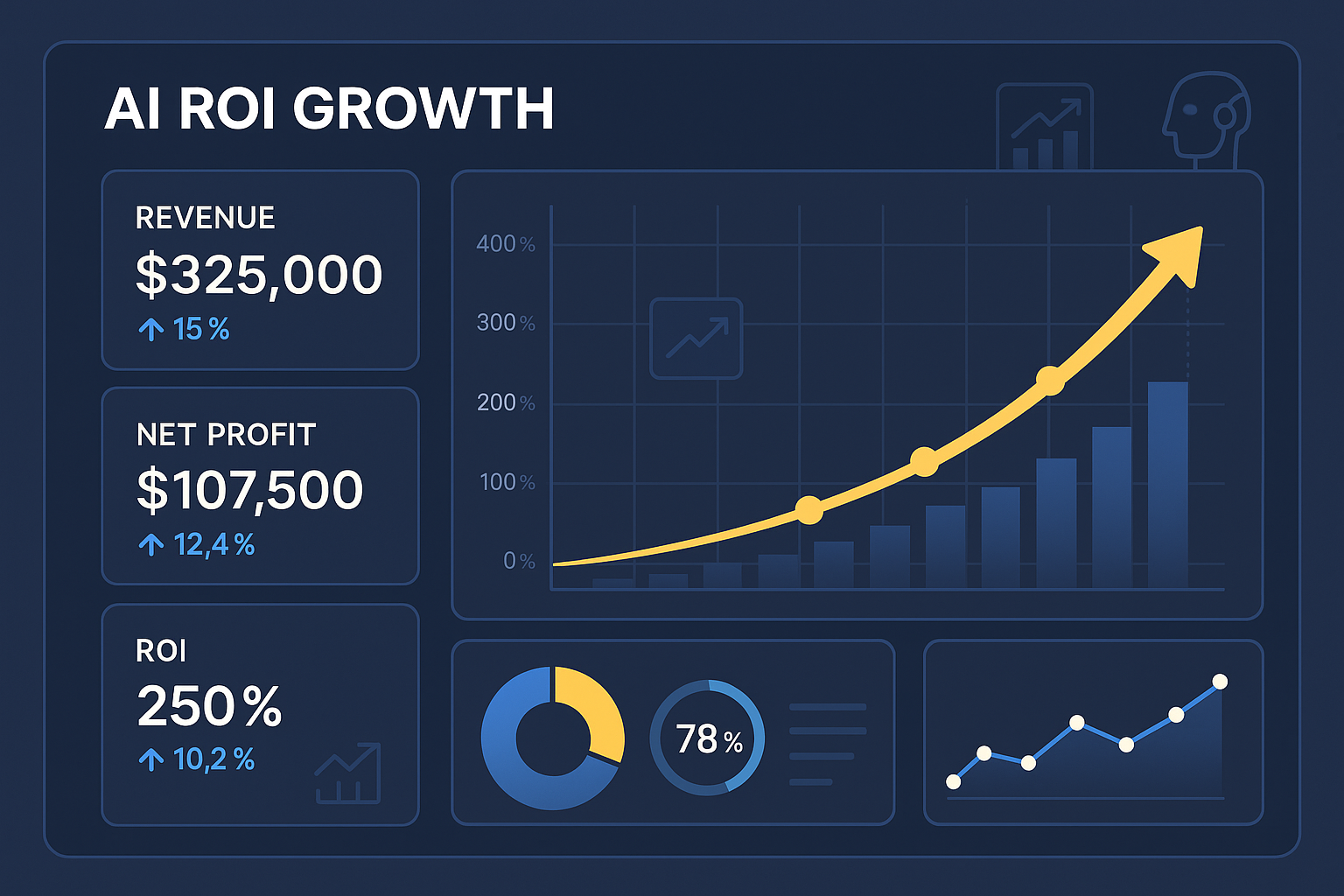
Building ROI Dashboards
Effective ROI communication requires visual, accessible dashboards that present key metrics clearly to different
stakeholder groups. Dashboards should be updated regularly and provide drill-down capabilities for detailed
analysis.
Executive Dashboard Components
Overall ROI Summary: High-level ROI percentage and trend over time
Financial Impact: Total cost savings and revenue improvements
Strategic Progress: Key strategic objectives and achievement status
Risk Indicators: Critical risks and mitigation status
Future Outlook: Projected benefits and upcoming initiatives
Operational Dashboard Components
Performance Metrics: Detailed operational KPIs with targets and actuals
Quality Indicators: Error rates, accuracy metrics, and quality trends
System Health: Technical performance metrics and system status
User Adoption: Usage statistics and user engagement metrics
Issue Tracking: Open issues, resolution times, and incident trends
Financial Dashboard Components
Cost Analysis: Detailed breakdown of implementation and ongoing costs
Benefit Tracking: Realised benefits by category with monthly trends
ROI Calculation: Detailed ROI formula with component breakdown
Budget Variance: Planned versus actual costs with variance analysis
Payback Period: Time to recover investment with projection updates
ROI Measurement Case Studies
Case Study 1: Customer Service Automation
Industry: Financial Services
AI Application: Intelligent chatbot for customer inquiries
Implementation Costs:
Platform and integration: $45,000
Training and change management: $15,000
Consulting services: $20,000
Total implementation: $80,000
Annual Ongoing Costs:
Platform subscription: $24,000
Maintenance and updates: $12,000
Total annual ongoing: $36,000
Annual Benefits:
Customer service cost reduction: $120,000 (40% fewer human interactions)
Extended service hours value: $30,000 (24/7 availability)
Issue: AI benefits often grow over time but initial ROI calculations may not reflect this.
Solution:
Calculate multi-year ROI projections with staged benefit realisation
Include capability building and strategic value in calculations
Update ROI calculations quarterly as benefits mature
Communicate expected benefit trajectory to stakeholders
Challenge 4: Cost Estimation Accuracy
Issue: Hidden costs and ongoing expenses often exceed initial estimates.
Solution:
Include contingency buffers in cost estimates (15-20%)
Account for all cost categories including staff time
Track actual costs meticulously for future planning
Update cost projections as new information emerges
Best Practices for ROI Measurement
1. Establish Baselines Early
Document current performance metrics before AI implementation begins. This provides clear comparison points for
measuring improvements.
2. Use Multiple Measurement Methods
Combine quantitative financial metrics with qualitative assessments and operational KPIs for comprehensive value
measurement.
3. Report Regularly and Transparently
Provide consistent, honest reporting of both successes and challenges. This builds credibility and supports
continuous improvement.
4. Adjust Metrics as Understanding Evolves
Refine measurement approaches as you learn more about AI impact. Add new metrics that better capture value
creation.
5. Celebrate and Communicate Wins
Share success stories and positive ROI results broadly. This builds momentum and support for future AI
initiatives.
ROI Measurement Tools and Templates
ROI Calculator Template
Use this template structure to calculate comprehensive AI ROI:
Implementation Costs
Software and platform costs: $_______
Hardware and infrastructure: $_______
Integration and development: $_______
Training and change management: $_______
Consulting and professional services: $_______
Total Implementation: $_______
Annual Ongoing Costs
Software subscriptions: $_______
Cloud and infrastructure: $_______
Maintenance and support: $_______
Staff time allocation: $_______
Total Annual Ongoing: $_______
Annual Benefits
Cost savings from automation: $_______
Revenue increases: $_______
Productivity improvements: $_______
Quality improvements: $_______
Other quantified benefits: $_______
Total Annual Benefits: $_______
ROI Calculation
Total Investment (Implementation + First Year Ongoing): $_______
Net Benefit (Annual Benefits - Implementation - Ongoing): $_______
First Year ROI: _______%
Payback Period: _______ months
Measurement Framework Checklist
☐ Baseline metrics documented before implementation
☐ Clear success criteria defined and agreed upon
☐ Measurement tools and systems implemented
☐ Data collection processes established
☐ Reporting schedule and stakeholder communication plan created
☐ Dashboard access provided to relevant stakeholders
☐ Regular review meetings scheduled
☐ Continuous improvement process defined
🎯 Chapter 6 Key Takeaways
AI ROI measurement requires comprehensive frameworks capturing direct, indirect, and strategic value
Establish clear baselines and success metrics before implementation begins
Track both financial and non-financial metrics for complete value understanding
Build visual dashboards tailored to different stakeholder needs and perspectives
Address measurement challenges proactively with robust methodologies and conservative estimates
Use case studies and benchmarks to validate ROI calculations and projections
Report regularly, transparently, and adjust measurement approaches as understanding evolves
Celebrate successes and use ROI data to build momentum for future AI initiatives
Chapter 7: AI Solutions for Small to Medium Businesses
Small to medium businesses (SMBs) face unique challenges and opportunities when implementing AI solutions. This
chapter provides practical guidance tailored specifically for SMB contexts, addressing budget constraints,
resource limitations, and scalability requirements whilst maximising AI benefits.
Understanding the SMB AI Landscape
SMBs operate in a fundamentally different environment from large enterprises. Limited budgets, smaller teams,
and resource constraints require different approaches to AI adoption. However, these constraints also create
opportunities for agility, focused implementation, and rapid value realisation.
Unique SMB Advantages in AI Adoption
Agility and Speed: SMBs can make decisions quickly without lengthy approval processes,
enabling faster AI implementation and iteration based on results.
Focused Application: Smaller operations allow for concentrated AI efforts on specific high-impact
areas rather than complex enterprise-wide deployments.
Direct Impact Visibility: In SMBs, AI improvements are immediately visible and measurable,
providing clear ROI demonstration and stakeholder buy-in.
Flexible Adaptation: SMBs can quickly pivot strategies and adjust AI implementations based on
market feedback and performance data.
Common SMB AI Challenges
Budget Limitations: SMBs typically have constrained technology budgets, making large AI
investments challenging without clear, rapid ROI.
Technical Expertise Gaps: Limited access to data scientists and AI specialists requires
reliance on user-friendly platforms and external expertise.
Data Maturity: Many SMBs lack organised data systems and quality processes needed for effective
AI implementation.
Resource Constraints: Small teams often wear multiple hats, limiting time available for AI
project management and implementation.
Budget-Friendly AI Solutions for SMBs
Modern AI platforms offer affordable, accessible solutions specifically designed for SMB needs and budgets. These
tools provide powerful capabilities without requiring massive investments or technical expertise.
Customer Service and Support
AI-Powered Chatbots: Platforms like Intercom, Drift, and Tidio offer affordable chatbot
solutions starting under $50/month. These tools handle routine customer inquiries 24/7, reducing support costs
whilst improving response times.
Implementation Approach:
Start with FAQ automation covering 80% of common questions
Integrate with existing website and communication channels
Train chatbot on your specific product and service information
Monitor conversations and continuously improve responses
Maintain human escalation path for complex issues
Expected ROI: 40-60% reduction in support ticket volume within 3 months
Marketing and Lead Generation
Email Marketing Optimisation: Tools like Mailchimp, Constant Contact, and HubSpot offer AI
features for send-time optimisation, subject line testing, and content personalisation at SMB-friendly price
points.
Implementation Approach:
Enable AI-powered send time optimisation for better open rates
Use AI subject line suggestions to improve engagement
Implement automated segmentation based on customer behaviour
Deploy personalised content recommendations
Track and optimise based on AI-generated insights
Expected ROI: 15-25% improvement in email engagement metrics within 2 months
Sales and CRM
Lead Scoring and Prioritisation: Platforms like Pipedrive, Zoho CRM, and Freshsales include AI
lead scoring that helps sales teams focus on highest-potential prospects.
Implementation Approach:
Configure lead scoring based on your historical conversion data
Set up automated lead assignment based on scores and territories
Implement AI-suggested next actions for each lead
Use predictive analytics to forecast sales pipeline
Optimise follow-up timing based on AI recommendations
Expected ROI: 20-30% increase in sales team productivity within 3 months
Operations and Productivity
Document Processing: Tools like Docparser, Rossum, and ABBYY offer affordable AI document
processing that automates data extraction from invoices, receipts, and forms.
Implementation Approach:
Identify repetitive document processing tasks consuming staff time
Configure AI extraction rules for your specific document types
Integrate with accounting and business management systems
Validate accuracy during initial deployment phase
Scale to additional document types as confidence builds
Expected ROI: 70-80% reduction in manual data entry time
Financial Management
Expense Management: Platforms like Expensify and Zoho Expense use AI to automatically categorise
expenses, detect policy violations, and streamline approvals.
Implementation Approach:
Set up expense policies and approval workflows
Enable receipt scanning and automatic expense creation
Configure AI categorisation rules based on your chart of accounts
Implement policy violation detection and alerts
Integrate with accounting systems for seamless reconciliation
Expected ROI: 60% reduction in expense processing time, improved policy compliance
Implementation Strategy for SMBs
Phase 1: Foundation Building (Month 1)
Assess Current State:
Identify biggest pain points and inefficiencies in operations
Evaluate current technology stack and integration capabilities
Assess team readiness and available time for implementation
Review budget constraints and investment capacity
Prioritise Opportunities:
Rank potential AI applications by impact and feasibility
Calculate estimated ROI for top opportunities
Select one or two initial projects with highest value-to-effort ratio
Secure stakeholder buy-in and resource commitment
Phase 2: Pilot Implementation (Months 2-3)
Deploy Initial Solution:
Select appropriate AI platform based on requirements and budget
Configure and customise solution for your specific needs
Integrate with existing systems and workflows
Train team members on new AI-powered tools
Establish performance metrics and tracking mechanisms
Monitor and Optimise:
Track performance against baseline metrics weekly
Gather user feedback and identify improvement opportunities
Adjust configurations based on real-world usage
Document successes and challenges for future reference
Calculate actual ROI and compare to projections
Phase 3: Scaling and Expansion (Months 4-6)
Expand Successful Applications:
Scale proven AI solutions to additional use cases or departments
Implement second-priority AI applications based on pilot learnings
Develop internal AI expertise and best practices
Build organisation-wide AI literacy and acceptance
Plan longer-term AI roadmap based on proven value
Cost-Effective AI Tools by Business Function
Customer Service
Tidio: Free plan available, paid plans from $19/month, live chat and chatbots
Zendesk: From $49/month, AI-powered ticket routing and responses
Freshdesk: Free plan available, AI suggestions from $15/month
Marketing
Mailchimp: Free plan available, AI features from $13/month
Canva Pro: $12.99/month, AI design assistance and content generation
Buffer: From $6/month, AI-powered social media scheduling optimisation
Sales
Pipedrive: From $14.90/month, AI lead scoring and sales assistant
Zoho CRM: Free plan available, AI predictions from $20/month
HubSpot: Free CRM with basic AI, advanced features from $45/month
Operations
Zapier: Free plan available, AI workflow automation from $19.99/month
Notion AI: From $10/month, AI-powered document creation and organisation
Grammarly Business: From $15/month, AI writing assistance
Finance
QuickBooks: From $30/month, AI expense categorisation
Expensify: From $5/month per user, AI receipt scanning
Wave: Free accounting with AI features included
SMB Success Stories
Case Study: Local Retail Store
Business: Independent clothing boutique with 2 locations
Challenge: Limited staff struggling with customer inquiries and inventory management
Solution: Implemented chatbot for customer service and AI inventory optimisation
Investment:
Chatbot platform: $49/month
Inventory optimisation tool: $79/month
Total monthly cost: $128
Results after 6 months:
60% of customer inquiries handled automatically by chatbot
Staff time freed up for in-person customer service
Inventory carrying costs reduced by 25% through AI optimisation
Stockouts decreased by 40%
Overall ROI: 450% in first year
Case Study: Professional Services Firm
Business: Marketing consultancy with 8 employees
Challenge: Time-consuming proposal writing and client reporting
Solution: AI writing assistant and automated reporting tools
Increased capacity allowing 3 additional client projects per month
Improved proposal win rate through consistency and quality
Overall ROI: 380% in first year
Case Study: Manufacturing SMB
Business: Small manufacturer with 25 employees
Challenge: Equipment downtime and maintenance costs
Solution: Predictive maintenance sensors and AI analytics
Investment:
IoT sensors: $3,000 one-time
AI analytics platform: $149/month
Total first-year cost: $4,788
Results after 8 months:
Unplanned downtime reduced by 70%
Maintenance costs decreased by 35%
Production efficiency improved by 15%
Equipment lifespan extended through optimised maintenance
Overall ROI: 520% in first year
Common SMB AI Implementation Mistakes
Mistake 1: Waiting for Perfect Conditions
Issue: Delaying AI adoption until data is perfect, budget is larger, or team is bigger.
Solution:
Start with available data and improve quality over time
Begin with low-cost solutions that deliver quick wins
Use AI success to build business case for additional investment
Leverage free trials to validate value before commitment
Mistake 2: Choosing Overly Complex Solutions
Issue: Selecting enterprise-grade AI platforms with features far beyond SMB needs.
Solution:
Focus on solutions designed specifically for SMB scale and needs
Prioritise ease of use over comprehensive feature sets
Select platforms with good SMB customer support and resources
Ensure solutions can grow with your business
Mistake 3: Neglecting Integration Requirements
Issue: Implementing AI tools that don't integrate with existing business systems.
Solution:
Verify integration capabilities before purchasing AI tools
Use integration platforms like Zapier for connecting systems
Consider AI platforms with native integrations to your existing tools
Plan for integration time and potential technical assistance
Mistake 4: Insufficient Team Training
Issue: Rolling out AI tools without adequate user training and support.
Solution:
Allocate time for comprehensive team training
Create simple documentation and quick reference guides
Designate internal AI champions to support other users
Provide ongoing learning opportunities as tools evolve
Mistake 5: Unrealistic ROI Expectations
Issue: Expecting immediate, transformational results from initial AI implementations.
Solution:
Set realistic timelines for value realisation (typically 2-4 months)
Focus on incremental improvements rather than complete transformation
Measure progress regularly against baseline metrics
Celebrate small wins whilst building towards larger goals
Building AI Capability in Your SMB
Develop Internal AI Champions
Identify enthusiastic team members who can become AI advocates and internal experts. Invest in their training
and empower them to lead AI initiatives.
Champion Responsibilities:
Stay informed about relevant AI developments and tools
Evaluate new AI solutions for potential business value
Support team members using AI tools
Identify new opportunities for AI application
Share best practices and success stories
Create a Learning Culture
Foster continuous learning about AI through accessible resources, experimentation, and knowledge sharing across
the team.
Learning Initiatives:
Monthly "AI showcase" meetings to share discoveries and results
Access to online AI courses and webinars
Encouraging experimentation with new AI tools
Recognition for AI-driven improvements and innovations
Budget allocation for AI skill development
Leverage External Expertise
Use consultants, freelancers, and technology vendors strategically to accelerate AI adoption without permanent
hiring costs.
External Resource Strategies:
Hire AI consultants for initial strategy and planning
Use vendor implementation services for complex deployments
Engage freelance AI specialists for specific projects
Participate in vendor training programmes and user communities
Join industry associations and peer learning groups
SMB AI Roadmap Template
Quarter 1: Quick Wins
Implement one customer-facing AI solution (chatbot, email optimisation)
Deploy one internal efficiency tool (document processing, scheduling)
Establish baseline metrics for measuring impact
Train team on new AI tools
Calculate initial ROI from implementations
Quarter 2: Expansion
Scale successful Q1 implementations to additional use cases
Add 2-3 new AI applications based on proven value
Develop internal AI champion programme
Optimise existing AI tools based on usage data
Document best practices and lessons learned
Quarter 3: Integration
Ensure AI tools are fully integrated with business processes
Implement cross-functional AI solutions
Establish governance and quality standards
Measure cumulative ROI across all AI initiatives
Plan next phase of AI adoption based on results
Quarter 4: Optimisation
Review and optimise all AI implementations
Retire or replace underperforming solutions
Plan more sophisticated AI applications
Build case for increased AI investment based on proven results
Develop year 2 AI strategy and roadmap
🎯 Chapter 7 Key Takeaways
SMBs can leverage affordable, user-friendly AI solutions starting under $100/month
Focus on specific, high-impact applications rather than comprehensive enterprise implementations
Start with quick wins that demonstrate value and build confidence for further AI adoption
Prioritise solutions designed for SMB needs with good support and ease of use
Develop internal AI champions and create a learning culture around AI capabilities
Leverage external expertise strategically without permanent hiring commitments
Measure ROI consistently and use results to justify expanded AI investment
Avoid common mistakes like waiting for perfect conditions or choosing overly complex solutions
Ready to Transform Your Business?
Let's Turn This Knowledge Into Action
You've learned the strategies - now it's time to implement them. Book your free 30-minute AI strategy consultation and discover exactly how to unlock AI's potential for your business.